
WDC Annual General Meeting to take place February 27, 2025
The AGM, which is open to all WDC Members, will take place as a Zoom teleconference, from 1:00 PM to 2:30 PM GMT.


The AGM, which is open to all WDC Members, will take place as a Zoom teleconference, from 1:00 PM to 2:30 PM GMT.

Embracing digital certificates is transformative, demonstrating how innovation can enhance the KP, WDC President Feriel Zerouki said at the closing 2024 KP Plenary. She referred to QR-coded secure digital certificates introduced by the UAE.

In her keynote speech, WDC President Feriel Zerouki emphasized the WDC’s commitment to strengthening the KP and promoting an equitable and sustainable diamond industry.

The World Diamond Council (WDC) concluded the 2024 Kimberley Process (KP) Intersessional with a renewed commitment to ethical practices, transparency and industry reform.

Feriel Zerouki reminded delegates of the KP Intersessional meeting in Dubai that Participants can choose to apply best practice over and above the minimum requirements of the KP.

World Diamond Council President Feriel Zerouki struck a cautiously optimistic note at the conclusion of the 2023 Kimberley Process Plenary on November 10, 2023, at Victoria Falls in Zimbabwe, after the Plenary agreed on 98 items.

Addressing the Opening Session of the 2023 KP Plenary at Victoria Falls in Zimbabwe on November 6, World Diamond Council President Feriel Zerouki emphasized the WDC’s determination to drive forward the ambition of the KP, which serves to foster peace, security and benefit all diamond stakeholders sustainably.

World Diamond Council President Feriel Zerouki has emphasized the heightened importance of responsibility, sustainability and provenance in the jewelry industry, specifically because its products are used to celebrate important life moments.

The 2023 Intersessional Meeting of the Kimberley Process concluded yesterday in Victoria Falls, Zimbabwe. Addressing the closing session of the gathering, World Diamond Council President Feriel Zerouki was positive about headway having been made during the four-day event.

In her first speech to the Kimberley Process as President of the World Diamond Council, Feriel Zerouki has stressed that the diversity of opinion and background of the KP’s members – Participants and Observers alike – should be considered not a deficiency but rather a source of strength.

She take office following three years as WDC Vice President and almost two decades as a leading advocate for enhancing standards and driving progress within the diamond industry.

The 2022 Kimberley Process Meeting ended successfully in the early hours of November 5, after a compromise proposal offered by the World Diamond Council managed to break an impasse that could have prevented the gathering dispersing without issuing a Final Communiqué.

With the KP about to mark the 20th anniversary of the launch of the Kimberley Process Certification Scheme (KPCS) in January 2003, it is important that the international forum not rest on the laurels of its early successes, the WDC President told the Opening Session of the 2022 KP Plenary in Gaborone, Botswana, on November 1, 2022.
The 2022 KP Plenary was expected to approve a new Ad Hoc Committee to oversee the next Review and Reform Cycle, which is undertaken every five years. The conflict diamonds definition, which has remained unchanged since 2003 and applies only to rough diamonds financing civil war, will be at key item on its agenda, Edward Asscher said.

If the Kimberley Process (KP) does not adopt the reforms necessary to ensure that its rough certification scheme remains relevant in a changed world, natural diamonds could lose relevance with the new generations of socially conscious diamond consumers, said WDC President Edward Asscher, in his address yesterday to the Opening Session of the KP Plenary in Gaborone, Botswana.

We may well be approaching a tipping point. If there ever was a time to take control over your destiny, rather than being carried along by the tide, it is now. With a global economic recession looming and geopolitical instability, I urge colleagues among our industry’s younger generation to help us preserve the integrity of natural diamonds, as an ethical product that is the economic driver for economies and societies across the globe.

Edward Asscher, President of the World Diamond Council, addressed the Presidents’ Meeting of the World Federation of the Diamond Bourses (WDDB) and the International Diamond Manufacturers Association (IDMA) at the Dubai Multi-Commodities Center (DMCC) in Dubai on February 24, 2022.

Speaking on June 24, 2022, during the closing session of the 2022 Kimberley Process Intersessional in the town of Kasane, Botswana, WDC President Edward Asscher noted a positive shift in the readiness of members to reforming the KP.

The special session considered the topics of natural resources, peaceful societies and sustainable development, with a focus on lessons from the Kimberley Process

Edward Asscher, President of the World Diamond Council, addressed the Presidents’ Meeting of the World Federation of the Diamond Bourses (WDDB) and the International Diamond Manufacturers Association (IDMA) at the Dubai Multi-Commodities Center (DMCC) in Dubai on February 24, 2022.

Vinod Kuriyan of the Rapaport news service, interviews Edward Asscher, President of the World Diamond Council, during the Dubai Diamond Conference on February 23, 2022.

The Young Diamantaires of the World Federation of Diamond Bourses (WFDB) hosted WDC President Edward Asscher on January 20, 2022, during a webinar on January 20, 2022, entitled “A lifetime of commitment to the diamond industry.”


Over its almost 19 years of operation, the KPCS has been remarkably successful in fulfilling its mission, eliminating almost entirely the trade in rough diamond being used to finance civil war. But it is limited in its scope, and unless that is expanded, it cannot be expected to be a panacea to other challenges afflicting artisanal miners, including human and labor rights violations, bribery and corruption.

“In the not-too-distant future, there will be a difference between rough diamonds that can be guaranteed to have fulfilled the consumers’ demands and expectations, and other diamonds,” said Edward Asscher, President of the World Diamond Council (WDC), speaking today during the closing session of the 2021 Intersessional Meeting of the Kimberley Process (KP).

“Consumers today want to know about a diamond’s provenance. They want to be assured that the diamonds they are considering buying have made a positive impact on the world,” said Edward Asscher, speaking today during the opening of the 2021 Intersessional Meeting of the Kimberley Process (KP).

Ahead of the 2021 Intersessional Meeting, the WDC News Update spoke with the KP Chair, Alexey Moiseev, who also serves as Russia’s Deputy Minister of Finance. He previewed the upcoming gathering, provided an overview of key subjects on the KP’s agenda, and considered the impact of COVID-19 on the diamond industry and the Kimberley Process Certification Scheme.

The World Diamond Council and the Natural Diamond Council hosted a webinar for representatives of Kimberley Process participant countries and civil society KP Observers on October 29, 2020, during which the NDC’s program for promoting natural diamonds in the international jewelry

The goals of the World Diamond Council are to preserve and protect the integrity of the Kimberley Process and the entire diamond value chain, WDC President Edward Asscher stressed in a video message during the opening of the the Guangzhou International Jewellery & Diamond Conference on October 29, 2020.

The year 2020 marks the 20th anniversary of two seminal events in the history of the diamond industry, both of them associated to the campaign to eliminate the trade in conflict diamonds. The first was the founding of the Kimberley Process (KP), the coalition of governments, industry and civil society that gave birth to Kimberley Process Certification Scheme (KPSC) and since then has overseen its operation.

The resolution, which was passed on March 3, 2020, welcomed efforts made to strengthen the Kimberley Process Certification Scheme (KPCS), including ongoing discussions on a definition of conflict diamonds, the importance of capacity‑building and mutual support, and the positive contribution that rough diamonds can make to prosperity and socioeconomic development.

While most media coverage of the 2019 Kimberley Process (KP) Plenary Meeting focused on the discussion around the “conflict diamonds” definition, it was only one of a great many subjects tackled during the five-day gathering in New Delh.

“The KPCS has been an absolutely critical element in maintaining peace in producing countries through increased traceability of rough diamond trade, and we must redouble our efforts to strengthen its impact,” said WDC President Stephane Fischler.

Speaking directly to government representatives at the start of the 2019 Kimberley Process (KP) Plenary Meeting in New Delhi, India, on November 18, Stephane Fischler, President of the World Diamond Council (WDC), has stated that, with the KP’s three-year reform and review cycle about to end, the governments alone hold the future of the Kimberley Process’ much anticipated reform agenda in their hands.

The final minutes are on the clock for the KP’s three-year review and reform cycle, which began in 2016 and will end at the Plenary Meeting under the chairmanship of India.

Over a 20-year span there are unlikely any diamond industry officials other than Mark Van Bockstael who racked up more travel time and hotel nights in some of Africa’s most volatile locations.

The KP is in the final few months of a three-year review and reform process, which is scheduled to end at the 2019 KP Plenary Meeting, which will be held in the Indian capital of New Delhi from November 11 to November 15.

It is a system that can be wieldy and cumbersome, but also effective, having the ability to eliminate the presence of almost all rough diamonds financing civil war within just several years of the KPCS being launched in 2003.

The WDC President called on participants to agree on the measures necessary for strengthening the KPCS’s impact, both in improving the lives and prospects of communities in the mining areas, and also in meeting the expectations of consumers in the jewelry markets.

He was speaking during the Opening Session of the 2019 Intersessional Meeting of the Kimberley Process (KP), which opened today in the Indian city of Mumbai.
Decisions that are taken over the next six months, as part of the review and reform process, will reverberate for years to come and impact lives and livelihoods all the way up and down the diamond value chain.
While somewhat narrower in focus than that of the OECD’s full due diligence guidance, it is our strong contention that the SoWs are a crucial component for implementing the OECD system in the diamond supply chain.

The resolution calls for a strengthening of the Kimberley Process (KP), to more effectively sever the link between the illicit transaction of rough diamonds and armed conflict.

The meeting is being conducted as part the United Nations General Assembly’s 73rd Session, and is entitled “From blood diamonds to peace diamonds: conflict prevention through the Kimberley Process.”

Nonetheless, the WDC considered as positive the noting in the KP Plenary’s final communique of the submission by the Canadian government of an expanded definition of conflict diamonds, which had been proposed by WDC and its fellow KP observer, the Civil Society Coalition (CSC).

The proposed change would expand the scope beyond rough stones that finance wars against governments, and supports the industry’s drive in protecting consumer confidence in diamonds and the value chain, as reflected by the System of Warranties (SoW) reforms recently launched by the WDC.

Specifically, the WDC is advocating for a broadening of the definition of conflict diamonds to address grave and systematic violence.

In a speech planned for later today, Stephane Fischler, Acting President of the WDC, is expected to reiterate the need for KP review and reform in the areas of scope of conflict diamonds, KPCS minimum standards, and long term implementation of KPCS directives via a Permanent Secretariat.

The meetings primarily focused on two topics: the support from the DRC in regard to KP reform and establishment of the Permanent Secretariat, and the process of formalization, registration and traceability of the artisanal miners in the DRC.
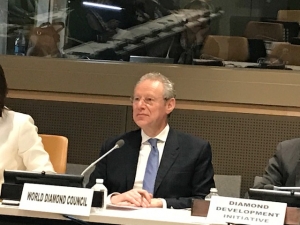
The side event in New York was entitled “The Kimberley Process, sustaining peace and achieving the 2030 Agenda for Sustainable Development: the diamond industry as a model for transforming lives.”